We’re thrilled at the initial results of our 2023 awarded grants. Together, we are truly building the foundation for industry-changing breakthroughs, through both follow-on grant applications to NIH and an increasing body of knowledge focused on achieving a better understanding of the genetic modifications that lead to brain aneurysm formation and rupture, with the ultimate goal of improving outcomes for patients and families affected by brain aneurysms.
Erin Kreszl, TBF Executive Director
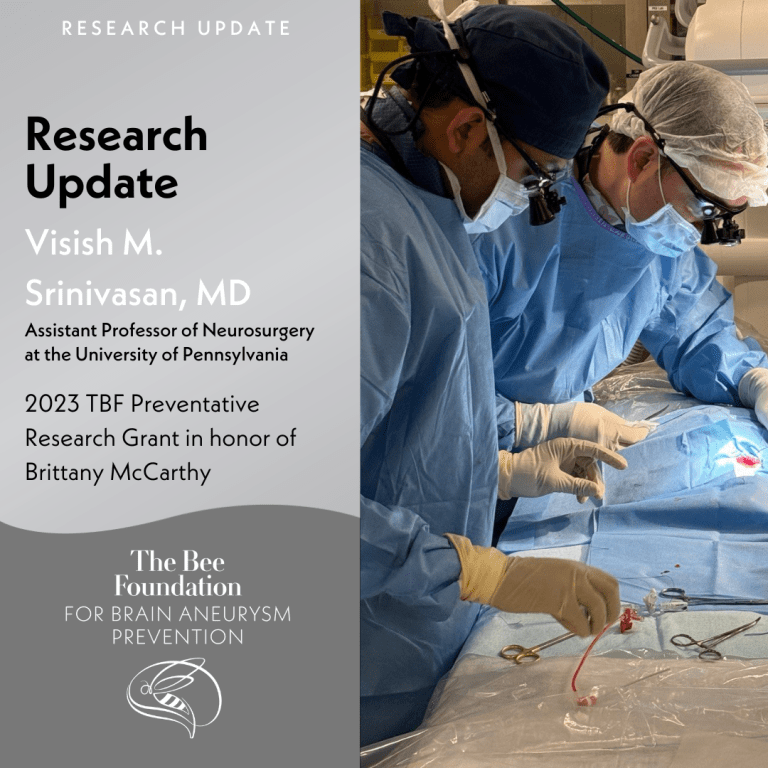
Erin Kreszl, TBF Executive Director, talks with Dr. Visish M. Srinivasan about the 2023 TBF Brittany McCarthy Research Grant examining the epigenetics involved in aneurysms.
Formal title: Defining the Epigenome of Intracranial Wide-Neck Bifurcation Aneurysms
 A Little Background
Dr. Srinivasan, along with his team, Dr. Oleg Shekhtman and Dr. Robert V. Gorman, received a 2023 TBF grant focused on the relationship of epigenetics to aneurysm formation. Epigenetics, as Dr. Srinivasan explains, studies the regulation of DNA and gene expression, which is responsive to environmental factors such as diet, toxins, stress, and lifestyle choices. Prior studies have suggested that DNA methylation (a mechanism of “gene silencing”) may contribute to aneurysm formation. However, a more comprehensive assessment of additional pathways is needed to fully explain the mechanisms that drive the growth of complex brain aneurysms. and the area holds promise for understanding how environmental factors, other than inheritance, affect aneurysm formation.
Their research aims to explore these issues by simultaneously studying the relevant factors in both humans and rabbits.
The Project to Date
Dr. Srinivasan’s team successfully developed a rabbit model of aneurysms, which closely resembles human structure and genetic biology. This model allows for the study of the epigenetic landscape to better understand alterations in human aneurysms.
How did our grant advance knowledge in the area of brain aneurysm diagnosis and treatment?
Promising Progress. The ultimate goal of the research project is to identify a “signature of epigenetic changes” — a unique set of genetic modifications that lead to brain aneurysm formation and rupture. Dr. Srinivasan’s team is well on their way with the successful development of the rabbit model and creation and sampling of a dozen experimental aneurysms over the past year.
Solid Foundation for Future Research. Ultimately, the team would like to build onto this pilot study for a larger grant from NIH. TBF grants are an essential element in “kick starting” that process, enabling researchers to build a track record and begin to demonstrate results that lead to promising discoveries and, ultimately, treatment approaches.