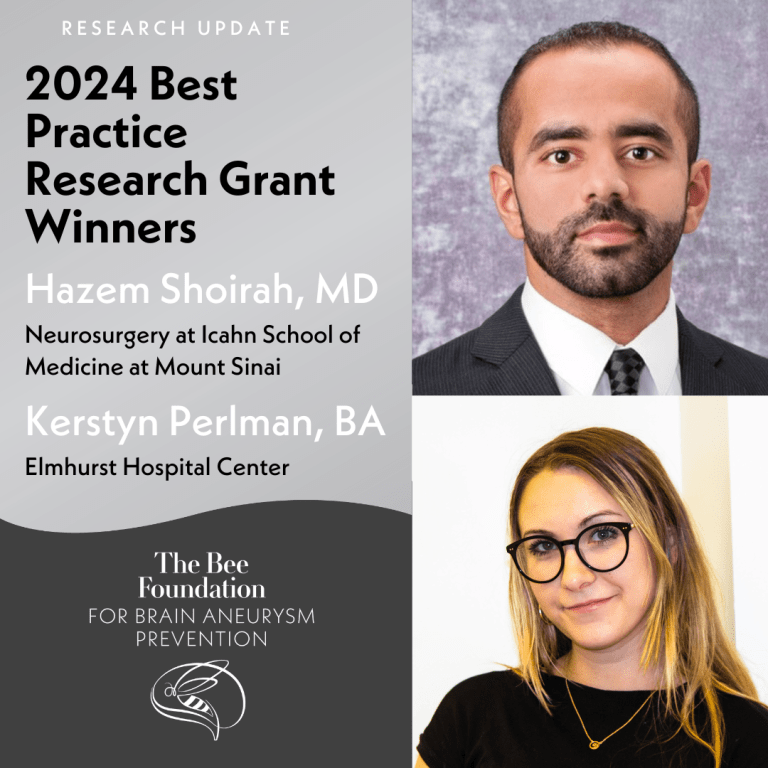
We are honored to announce the recipients of the first TBF Best Practices Research Grant. The Best Practices Grant Program focuses on the development of brain aneurysm best practices in the areas of identification, treatment and recovery. The program has three major initiatives which are to educate healthcare professionals and first responders on the early identification of bran aneurysms, research studies that improve patient outcomes related to transportation and the development of improved resources for patients and families after experiencing a brain aneurysm rupture.
Principal Investigator: Hazem Shoirah, MD, Associate Professor of Neurosurgery, Neurology and Radiology at Icahn School of Medicine at Mount Sinai, New York, NY Director of the Cerebrovascular Surgery Division at Elmhurst Hospital Center, Queens, NY
Co-investigator: Kerstyn Perlman, BA, Clinical Research Coordinator Cerebrovascular Surgery Division at Elmhurst Hospital Center, Queens, NY
Name Of Project: Impact of Race, Socioeconomic Status, and Healthcare Accessibility on Presentation and Outcome of Patients with Ruptured and Unruptured Intracranial Aneurysms in the Boroughs of Manhattan and Queens
What We Liked: The area of health equity and the development of best practices is of critical interest to TBF. Understanding the factors at play in the disproportionately affected populations of women, Hispanics, and blacks can reduce disparities in diagnosis and treatment and lead to vastly improved outcomes. Furthermore, we were keenly interested in the focus on both pre-rupture care and recovery related to access throughout the hospital system and transport between facilities. The ability to replicate the study to different geographical areas is a key determinant of our best practice studies.
Recently, Erin interviewed Hazem and Kerstyn to get some additional information on their proposal.
Erin: From previous conversations, I know that Hazem spent a lot of his early medical career in Cairo before he came to the US and ultimately Mt. Sinai, that he is the principal researcher and Kerstyn will be supporting that effort as well as doing some independent research at Elmhurst. Can you explain a little bit about the relationship between the two facilities?
Hazem: Elmhurst is sort of a sister hospital to Mt. Sinai. It is not actually part of the Mt. Sinai network, but is part of the HHC (NY City Health and Hospitals Network, which is city run. The demographics of the population are quite different, with Mt. Sinai having more clinical and academic expertise, and Elmhurst having a more diverse, underserved population. This presents us with an excellent opportunity to develop our current study.
Erin: Yes, let’s get to the study! In your proposal, you state that the primary aim is to explore the disparities found between, and among, two hospital systems in the New York City metropolitan area. Obviously, that is a perfect fit with the kinds of issues we want to explore in our health equity focus.
Hazem: That’s right. Obviously, we know that ruptured intracranial aneurysms with subarachnoid hemorrhage (aSAH) are significant public health concerns due to their potential for devastating outcomes. The American Heart Association (AHA) guidelines say that up to 26% of aSAH patients will die prior to hospital admission. We also know that variables among patients such as race, socioeconomic status, and access to specialized care may impact the recognition and treatment of patients with unruptured intracranial aneurysms, and that of course in turn impacts the outcomes. These variables have been documented, but we really need more investigation to confirm “what we know” and to develop targeted interventions.
Our study aims first, to assess the impact of the geographic location
(essentially for this study, Mt. Sinai vs. Elmhurst) on initial clinical presentation, management and outcomes of patients with aSAH and second, to look at the impact of factors including race and socioeconomic status on outcomes for those same patients. We’ll also be investigating the impact of different practices governing admission to comprehensive stroke centers as well as the costs of both acute and long term care in these locations.
Erin: Clearly you’ve seen this play out between Elmhurst and Mt. Sinai.
Hazem: Absolutely. Because of the differences in patient demographics and available expertise, we have a lot of areas where there are discrepancies that we want to look at. For example, one arm of our study is focused on pre-rupture care – what happens in terms of access to treatment and availability of treatment between Elmhurst and the rest of the Mt. Sinai network. Another arm is outpatient care following a rupture. In these areas, we will also be looking at where they are treated first, how they are transferred and when. In fact, the transport system is something we will be concentrating on quite a bit.
Erin: That’s an example of one area where this research can easily translate to other areas with similar demographics and infrastructure. And that’s something we really are passionate about – lifting the knowledge through findings that can be applied across the board, a sort of toolkit that could work in different geographies or situations.
Hazem: Absolutely, that applies in this case. For instance, since HHC is a huge state run provider, what we learn about HHC here will be applicable to other state run facilities. In another example, NYC is clearly a very big city and if we were to identify, for instance, a delay in getting to care as a key variable in outcomes, and traffic as an element of that, what we learn about effects and mitigation can be applied to other large cities with similar infrastructure challenges. And not just within the United States!
Erin – Yes, the implications for global sharing are exciting. So, what would you identify as your key goals?
Hazem: Hopefully, we will be able to contribute some valuable insights on the impact of race, socioeconomic status, and access to specialized care for aneurysms – ruptured and unruptured – as they play out in a busy city setting. More and better insights are really critical for healthcare providers to optimize their resources, better target them, and organize systems of care that can reduce inequities in the neurological arena.
Erin: And a successful outcome?
Hazem – First identify the elements of inequity. Accurately describe what the gaps are in care. Language barriers? Transport? Availability of experts? And then, design specific and targeted interventional steps to address those gaps.