I had a dull headache for weeks, but wasn’t concerned, as I would get frequent headaches from sinus infections and stress. On this particular day while working for the First Judicial District of Pennsylvania, during the lunch break, the judge’s judicial aide noticed I had my head on the desk in the courtroom. She asked if I was okay and I told her I wasn’t feeling myself. While driving home, which was a 45-minute drive, I decided to pick my son up, who was seven at the time, from the neighbor’s first instead of going home and then pick him up because of how I was feeling. Thankfully, the rupture didn’t happen while I was driving.
I had gone into my kitchen to take a phone call and after that phone call, I remember feeling a loud pop in my head. And then I, literally, saw stars. My son, Julian, was sitting on the couch. He said I was clutching my head on the couch as if I had a headache. I told him if anything happens call 9-1-1, but when I saw the tears coming down his face, I knew I had to do something immediately.
 I called my neighbor and was taken to the local hospital. I remember sitting in the waiting area for a while because I neglected to tell them that I heard a pop. I was eventually taken into an exam room and the doctor comes in and asks me my symptoms and I told him I had a headache, bad headache. I still didn’t mention the pop. He gave me a shot of Demerol as if he was treating me for a migraine and said I’ll come back and check on you.
So, I laid there for a while. He came back in and said, so, how are you feeling? I said I feel a little better. And he said, okay, we’re sending you home. I said, but, how come when I massage my temples, it’s extremely tender? He said, we’re doing a CT scan. I remember there being a lot of people in the room. And all of a sudden, there was this applause, and I didn’t understand it at the time, but they had found where the bleed was and so, that’s how I knew they found the bleed, that I had aneurysm.
I had never heard of an aneurysm. I didn’t know what was going on. I just know that when they were preparing me for surgery, the doctor was telling me what my chances were, which were 60/40. I’m thinking, wow, 60/40. He also said that of the 60% who survive, 70% have neurological deficits.
I’m hearing him say all of this, but it’s not registering at the time. All I know is in my mind it’s not my time yet. I have a lot more living to do.
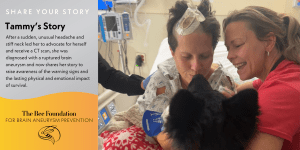
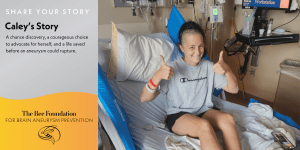
When I woke up, of course, I had that, I made it, you know, I’m alive, I’m here feeling, but just seeing all the tubes and the blood draining and everything going on, it was a lot. I’m there in that bed with all these machines and everything, I knew it wasn’t going to be anything quick, like I would be released quickly. One of the neurosurgeons did tell me that even though I had come through the surgery okay, I wasn’t out of the woods, he said I could have a vasospasm, a stroke.
I was feeling excited initially, but then when he said that, I think he told me like two weeks they had to watch me. I was in ICU for almost a month. I was medically cleared to return to work in six months as an official court reporter for the City of Philadelphia.
 Several years later another aneurysm was found after a routine MRI. That was less invasive than my first craniotomy. Some years later after my second craniotomy, while working in court, I had a case where a woman had a TBI. I wasn’t sure I would be able to do it without getting emotional, but I did. During one of four breaks, an attorney said to me that I didn’t seem phased by the terminology. I said to him that I don’t tell too many people this, but I’m a two-time brain aneurysm survivor and familiar with the terminology. Medical terminology is part of our curriculum in court reporting school.
I transitioned from court reporter to realtime captioner. I’ve provided captioning services for a Deaf patient at NIH who had a craniotomy. I shared with the patient’s neurosurgeon that I was a brain aneurysm survivor. He asked, “What hospital?” I told him “Thomas Jefferson University Hospital in Philadelphia.” He said, “Good hospital.” I said, “Dr. Robert Rosenwasser”. He said, “He’s a legend. “
 When asked how did these experiences change my outlook on life, I said, first, glad to be alive and having gotten through something like that, I have a very positive outlook on life. I look at the glass as half full instead of half empty. I try not to dwell on negative things that have either happened in the past or the present. I just look at the bright side of everything and just try not to let anything bother me or cause me stress because it’s not worth it, as tomorrow is not promised.
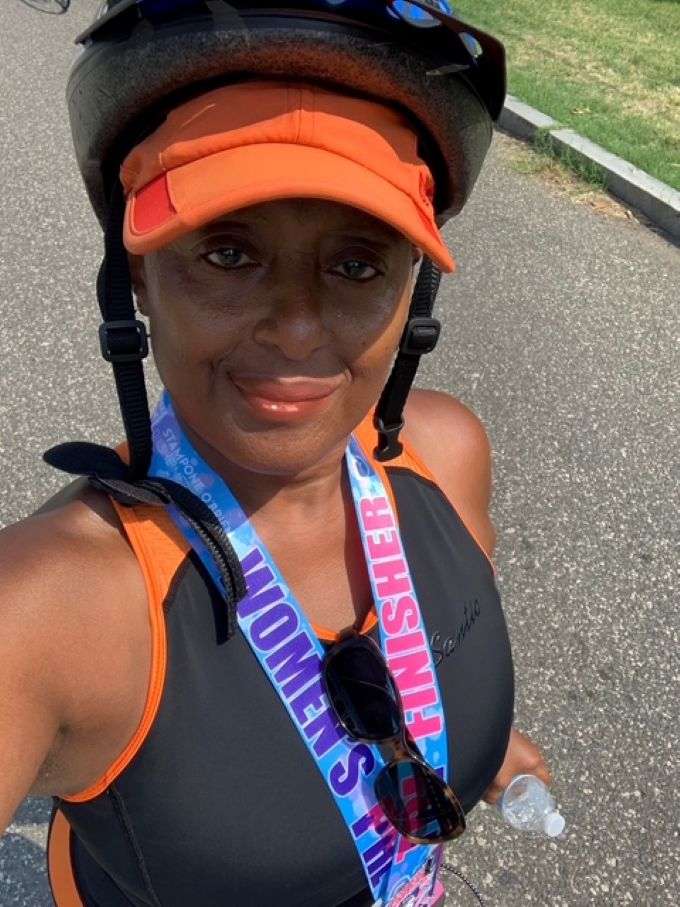
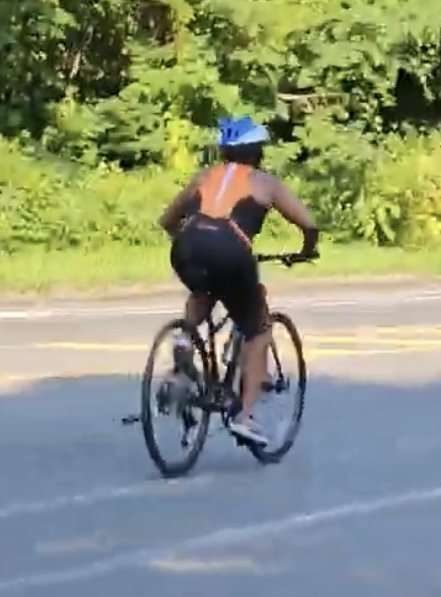
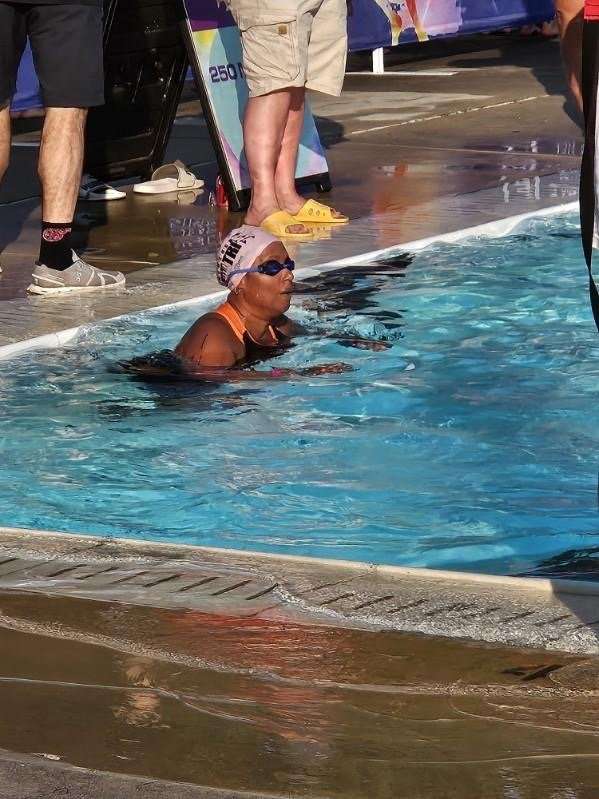
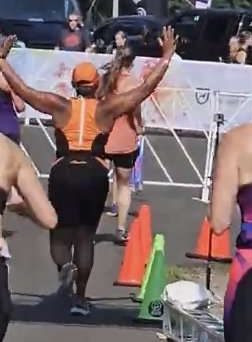
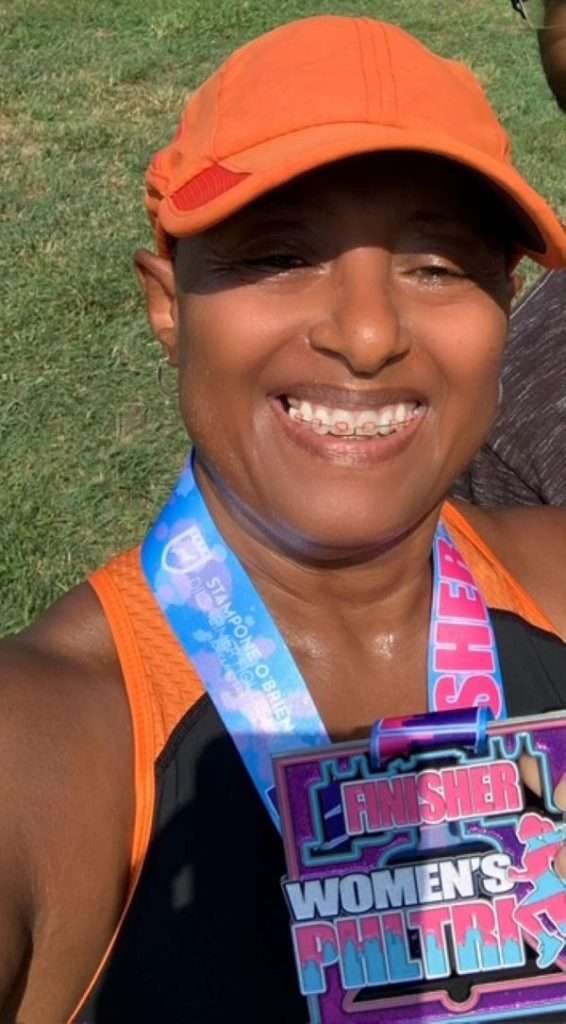
When asked what did I rely on to get through this life changing event, because of my faith, God, my church family. They were very instrumental and very helpful and very supportive. My aunt who helped raise me, she was very supportive. This experience has changed my priorities and goals in that instead of thinking about doing things, I think I’m more apt to just go ahead and try different things. For example, I did my first triathlon at 64. I love to swim. I do all three disciplines. I’ve done them all my life, just not competitively. It was very challenging and the fact that I did it, didn’t finish first and I didn’t finish last, but I finished. That was quite an experience. I was very proud of myself.
I’m here for a purpose. There’s a reason I’m still here, and I believe it is to spread the word, to spread awareness.