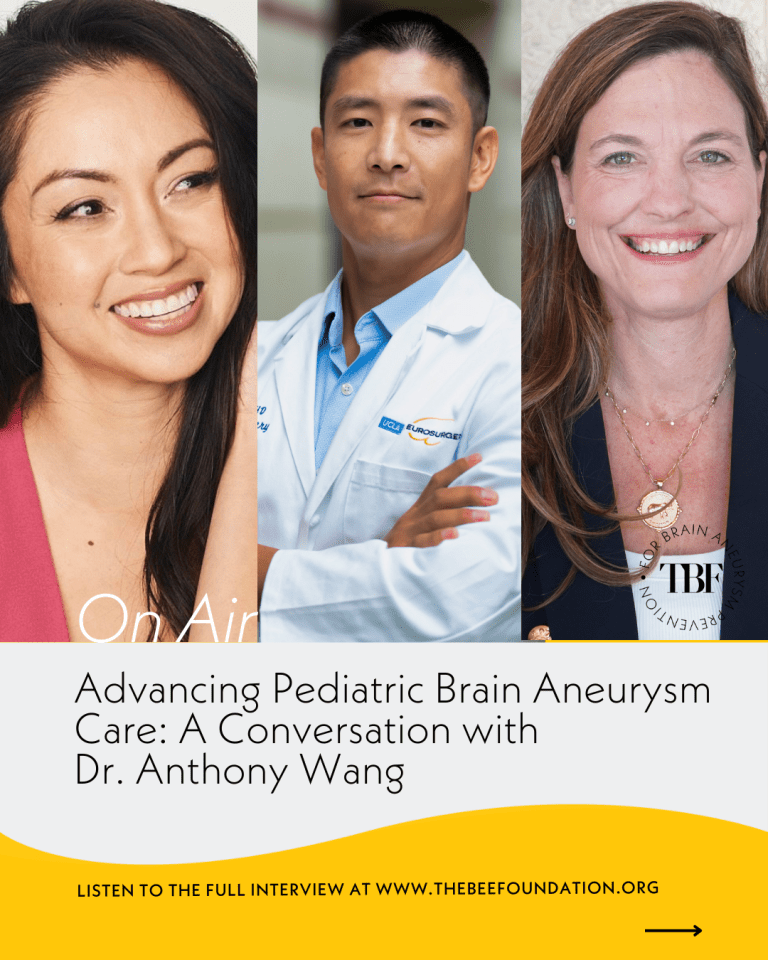
At The Bee Foundation for Brain Aneurysm Prevention, our mission is to save lives and provide hope by funding innovative research, advocating for policy change, and supporting those impacted by brain aneurysms. Recently, awareness ambassador and brain aneurysm survivor Cat Navarro Lee sat down with Dr. Anthony Wang, a distinguished neurosurgeon at UCLA, and Erin Kreszl, co-founder of The Bee Foundation, to discuss groundbreaking advancements in aneurysm treatment, pediatric care, and the importance of community support.
A Personal and Professional Passion for Neurosurgery
Dr. Wang’s journey into neurosurgery began with a natural aptitude for precision and problem-solving. His career trajectory aligned with the revolutionary advancements in aneurysm treatment, particularly the development of minimally invasive techniques like aneurysm coils. These innovations transformed the field, reducing the need for traditional open-skull procedures and improving patient outcomes. Today, Dr. Wang works alongside the pioneers of these technologies at UCLA, furthering research and improving treatment approaches.
Treating Pediatric vs. Adult Brain Aneurysms
While aneurysms in adults often result from lifestyle-related factors like high blood pressure and smoking, pediatric aneurysms tend to have developmental or genetic origins. As Dr. Wang explained, treating aneurysms in children is particularly complex due to their rarity and the unique anatomical challenges they present. Each case requires a multidisciplinary approach, involving specialists from various medical fields to determine the best course of treatment.
Unlike adults, children are more likely to present symptoms due to aneurysm growth rather than rupture, which can make early diagnosis more feasible. However, the rarity and complexity of pediatric aneurysms make research and collaboration crucial to improving outcomes.
The Role of Genetics in Brain Aneurysm Risk
One common concern among survivors, including Cat, is whether brain aneurysms have a hereditary component. According to Dr. Wang, while certain genetic susceptibilities exist, aneurysms are more commonly linked to lifestyle and vascular health factors rather than directly inherited traits. Current research, including work by Dr. Wang and Dr. Achyut Chen at UCLA, is exploring the genetic and epigenetic influences on aneurysm formation, with the goal of improving risk assessment and prevention strategies.
For individuals with two or more first-degree relatives who have experienced aneurysms, screening may be recommended. However, for those with more distant family history or no known risk factors, routine imaging is generally not advised.
The Importance of Post-Treatment Support
Recovering from a brain aneurysm is not just a medical process—it’s a lifelong journey that affects both patients and their families. Dr. Wang emphasized the critical need for post-treatment support, including access to neurorehabilitation, cognitive therapy, and family education.
Through the efforts of The Bee Foundation and supporters like those attending the upcoming Cornerstone Winter Wine Dinner, funding will directly contribute to patient care at UCLA. This includes helping aneurysm survivors recover, providing resources for affected families, and supporting individuals impacted by both brain aneurysms and the recent devastating California wildfires.
Looking Ahead: Hope for the Future
Over the past 15 years, brain aneurysm research has evolved significantly. The introduction of cutting-edge technology, a better understanding of genetic risk factors, and advancements in minimally invasive procedures have all contributed to better outcomes for patients. Dr. Wang remains optimistic about the future, particularly in the areas of early detection and risk stratification, which will allow doctors to intervene before an aneurysm becomes life-threatening.
By supporting advocacy efforts, raising awareness, and funding critical research, we can continue to make a difference in brain aneurysm prevention and treatment. Events like the Cornerstone Winter Wine Dinner are essential in driving these initiatives forward, ensuring that those affected receive the best possible care and support.
Join Us in the Fight Against Brain Aneurysms
Whether through fundraising, advocacy, or simply spreading awareness, your involvement matters. Together, we can create a future where fewer families suffer from the devastating effects of brain aneurysms.
Donate to the TBF UCLA Brain Aneurysm Support Community of UCLA which will provide resources relating to the diagnosis, investigation, treatment, and recovery process for patients, survivors, and caregivers.