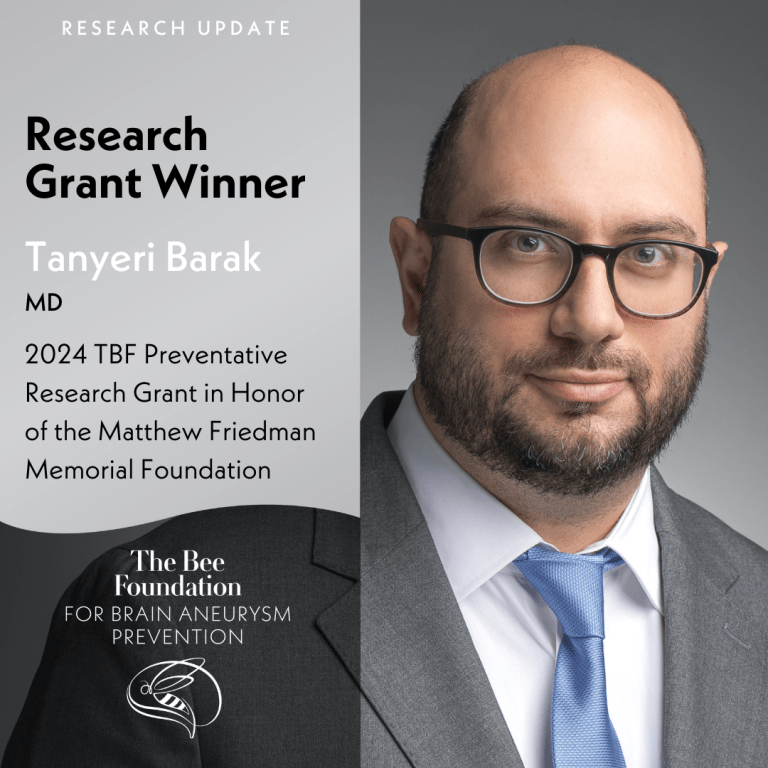
TBF Announces the Mathew Friedman Memorial Brain Aneurysm Preventative Research Grant
We are honored to announce the recipients of the TBF 2024 Preventative Research Grant Cycle. This year’s grant cycle was very strong prompting J. Mocco, head of the SAB, to comment that only the number of proposals received, but their impressive quality, indicated that TBF was now a true catalyst for the kind of seminal work that could turn into breakthrough research and ultimately major NIH dollars.
Each of our research grants has been generously supported by a different family who has been touched by brain aneurysm and is dedicated to funding preventative research. This grant has been awarded by the Matthew Friedman Memorial Foundation, which is dedicated to honoring the memory of Matthew Friedman who unexpectedly passed away from a ruptured brain aneurysm at the age of 19 on April 12th, 2023. Matthew was a brilliant, caring, passionate, and extremely loved young man. He was a Freshman at Cornell University pursuing his dream of becoming a doctor and he also dedicated his time to serving his community as an EMT with the local first aid squad, embodying his commitment to helping others in their times of need. The Foundation honors his memory by supporting brain research, local high school scholarships and supporting volunteer Emergency Medical Services. The Bee Foundation is honored to be the first recipient of a grant dedicated to brain aneurysm research in Matthew’s name. Please click here to learn more about the Matthew Friedman Memorial Foundation.

Grant #1:
Investigator Name: Tanyeri Barak, MD, Yale University
Name Of Project: WES identifies Genetic Risk Factors of Subarachnoid Hemorrhage in Pediatric and Young-Adult Patients
What We Liked: Barak’s research is right in our wheel-house, zeroing in on risk factors of subarachnoid hemorrhage (SAH) in younger adults, a population that, while less prone to the disease, is particularly devastated by the outcomes and often doesn’t display the most commonly looked for risk factors.
More From Barak and Erin
Erin: Thanks for talking with us Dr. Barak! First, we’d like to get some idea of you and the work you’ve done up to this point.
Dr. Barak: Of course! So I am Tanyeri Barak, a medical doctor with my degree from the University of Istanbul. Right now, I am Assistant Professor of Neurosurgery at Yale School of Medicine. For many years now I have been working with Dr. Murat Gunel – I did my post doctoral work with him. He is a vascular neurosurgeon and one of the leaders in risk factor identification in intracranial aneurysms (IA).
Erin: I know your work in the field has led you to this research project, and our SAB was really impressed with what you submitted! We want our supporters to be as excited about the research as we are, and that means getting a good understanding of what can be extremely technical, as I’m sure you know!
So let me start with your application. In it, you write that your research “aims to elucidate the impact of RAPGEF5 loss on cerebrovascular morphology using a mouse model and to analyze its effect at cellular and transcriptomic level through single nucleus RNA sequencing of the mouse brain arteries.” Can you help us explain that in layman’s terms for our readers?
Dr. Barak: I understand! So as we say in the application, the research is aimed at young patients with a subarachnoid hemorrhage (SAH) from a ruptured aneurysm, and we are hoping that, through gaining new insights into the underlying genetic risk factors, it will provide a foundation for targeted therapeutic interventions to prevent catastrophic vascular events in young patients with a brain aneurysm.
Erin: By young patients, you are talking about 11-35 year olds, right?
Dr. Barak: Yes. Let me provide some background. For more than 15 years, our team, along with others, has been investigating the genetic risk factors associated with brain aneurysms. These studies provided critical insight into aneurysm formation. We know that certain risk factors can be involved in the development of SAH, but knowing about these risk factors is not enough to allow reliable prediction of who is going to experience this condition. This gap is particularly evident in young people who often do not display any of the risk factors most commonly associated with aneurysms like overweight, hypertension, smoking etc. The absence of these more common risk factors suggests that genetic predispositions may play a more significant role in SAH in younger people.
To address this question, our team recently completed whole exome sequencing (WES) on 110 young adults and children aged 11 to 35 years who have been diagnosed with SAH. This work enabled us to identify a specific gene, RAPGEF5, that may play a significant role in SAH. Our current TBF-funded research is designed to explore this hypothesis.
Erin: How will you accomplish this?
Dr. Barak: We will be testing this hypothesis – which we identified with a human population – using mice, what we call a mouse model. As we say in the research, RAPGEF5 “surpassed the genome wide significance threshold,” involved in “various key cell signaling pathways associated with vascular development and vessel wall integrity.” Basically, we want to understand how the loss of RAPGEF5 impacts cerebrovascular morphology and integrity, such as cell type and cell death. We also want to explore the cell types and pathways most significantly affected by RAPFEF5.
The hope is that we could use the changes in this gene to better predict the development or incidence of SAH.
Erin: Thank you Barak. We’re excited to be funding research so closely aligned with our mission and purpose as well as our personal experience – as you know, TBF was founded in the wake of the death of our 27-year old cousin, so the incidence and impacts of SAH on young adults is something we clearly feel, not just from that experience but the shared experiences of our supporters around the world. It is also fitting that this grant was funded in honor of Matthew Friedman who passed away at the age of 19. We look forward to hearing much more as your research evolves!